
Who Am I Becoming? Storytelling as a Tool for Finding Direction
5 Min Read
Try this. Fill in the blanks:
"I used to ___, but now I ___."
Take a second. Whatever came to mind, you just did something remarkable. You took two moments from your life, connected them, and found a change worth noticing. In one sentence, you told a story about who you are.
We do this constantly, mostly without realizing it. And it turns out that how we tell those stories might matter more than we think.
Your life is a story you're still writing
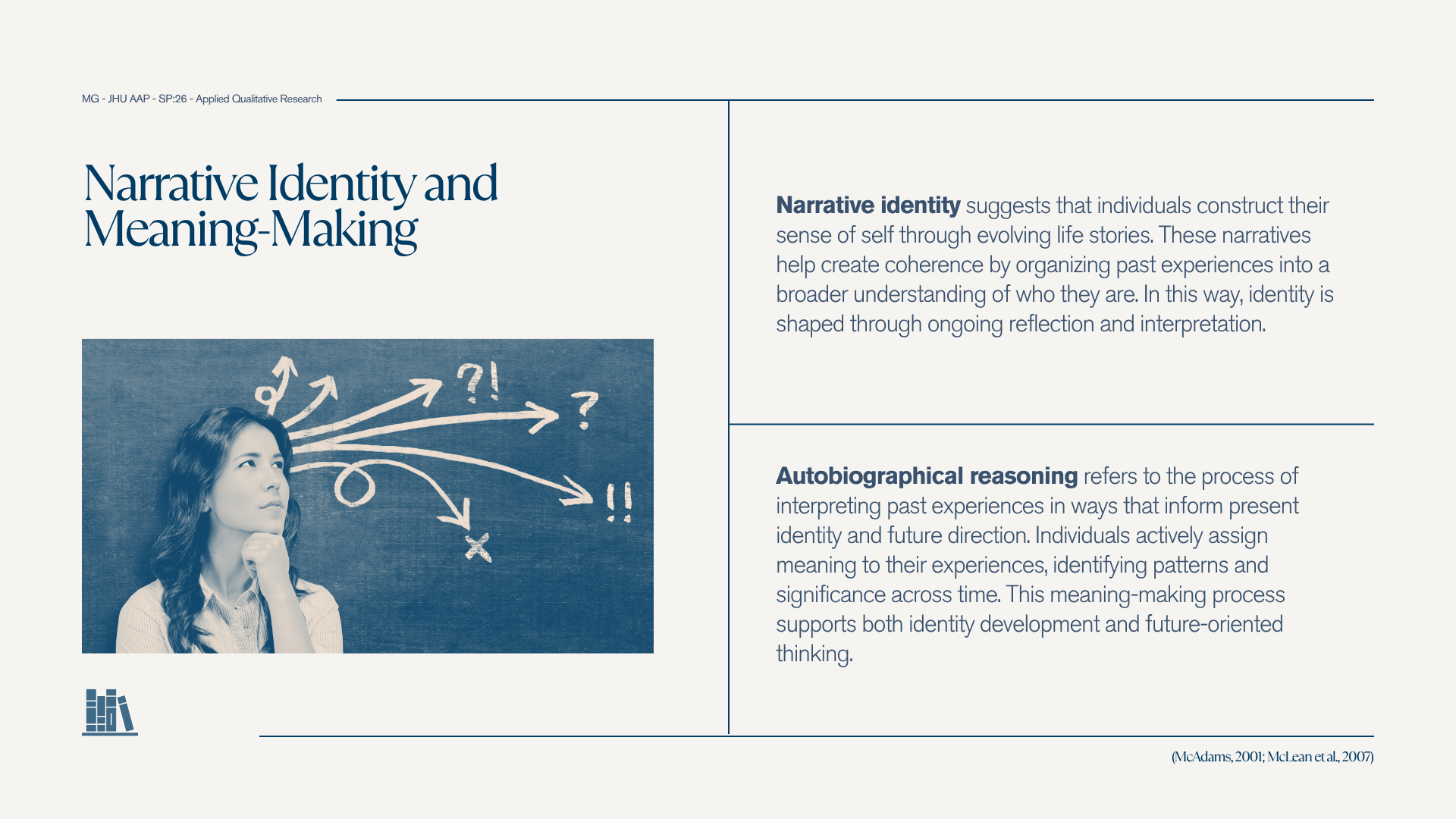
Psychologists have a name for this: narrative identity. The idea is that each of us carries an internal life story, one that ties together "the reconstructed past and imagined future to provide life with some degree of unity and purpose" (McAdams & McLean, 2013, p. 233).
The key word there is reconstructed. Our experiences don't define us on their own. The meaning we give them does. Two people can live through the same layoff, the same move, the same breakup, and walk away with completely different stories. One says, "That's when everything fell apart." The other says, "That's when I figured out what I wanted."
And the stories matter. A major review of the research found that the way people tell their life stories predicts their well-being, even after accounting for personality traits (Adler et al., 2016).
The decade of big decisions.
Life has a strange sense of timing.
Right around the point when most of us are still learning to do our own laundry, deciding that cereal counts as dinner, and calling home to ask how long you boil an egg, we're handed the biggest decisions of our lives. Pick a major. Pick a career. Pick a city. Maybe pick a person to spend forever with. No pressure.
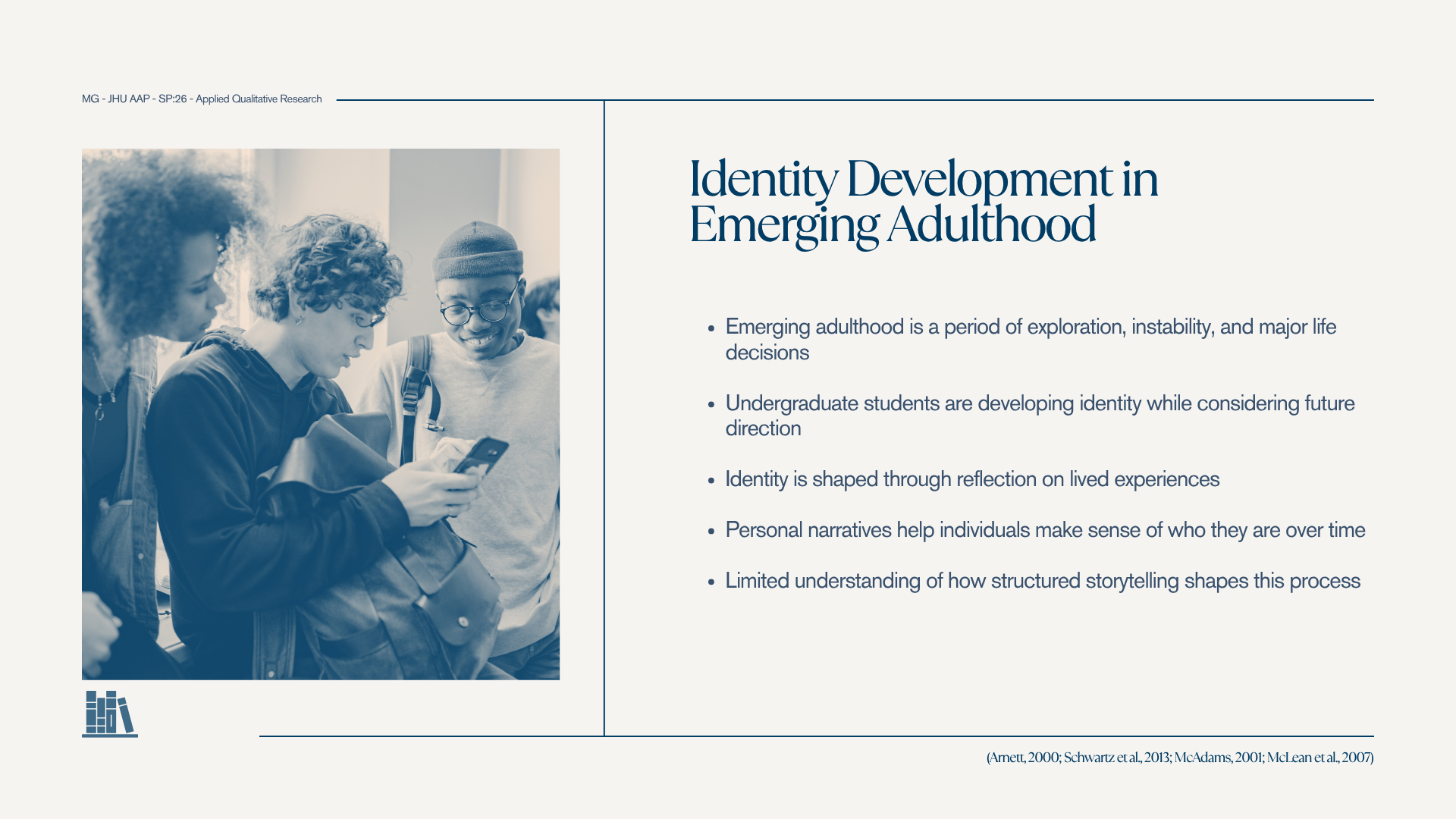
Psychologist Jeffrey Arnett gave this stretch of life, the late teens through the twenties, a name: emerging adulthood (Arnett, 2000). It's the decade of big decisions, and we have to make them while we're still figuring out who we are (Schwartz et al., 2013).
Some people move through it with growing clarity. Others get stuck in what researchers call ruminative exploration: circling the same questions over and over without ever landing anywhere (Luyckx et al., 2008). If you've ever lain awake replaying every possible version of your future, you know the feeling.
Now, here’s the part that I love.
Stories don't just describe who we are. They help shape who we become.
Researchers have proposed that we change ourselves "through the incremental telling of situated stories to multiple audiences and in multiple contexts" (McLean et al., 2007, p. 264). Every time we tell a story about our lives, we're not just reporting. We're revising. Putting experience into words helps us process it and make sense of it (Pennebaker & Chung, 2011). Narrative therapists go a step further: they help people re-author the stories that hold them back, and watch their sense of self shift along with the story (White & Epston, 1990).
When I read that, my mind went straight to one thought: if the stories we tell shape who we become, then how we tell them should matter too.
Because most of us aren't really telling our stories. We're running them on autopilot, repeating the same versions of ourselves without stopping to ask what they mean or where they're pointing.
But telling a story is a skill, and skills can be learned. What if we learned to tell our own stories with intention: choosing the moments that mattered, noticing what changed, and naming what it meant? Maybe then we'd stop being characters that life happens to and start narrating our own lives.
So here's what I want to know: can learning to tell a personal story change how we understand who we are, and where we're going?
Where the research thins
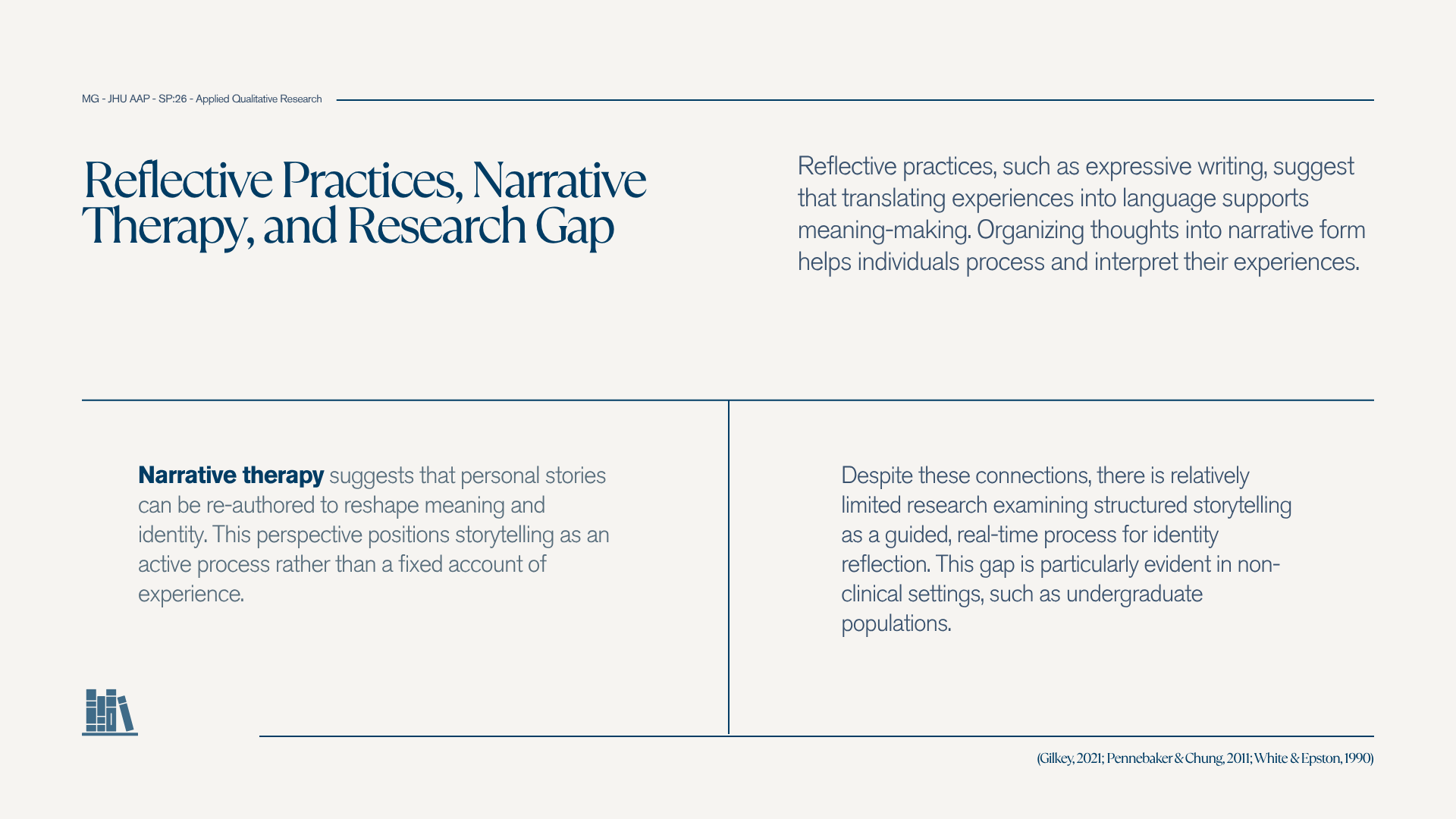
Here's the surprising part: we know a lot about why our stories matter, but much less about what happens when we teach people to tell them.
Most studies look at the stories people tell naturally, after the fact. Far fewer look at what happens when someone is guided through telling a story in real time.
Where guided storytelling has been tested, it's mostly been in therapy or in very specific settings. One of the most promising examples comes from a team at Boise State University who brought storytelling into undergraduate engineering courses (Jankowski et al., 2025). Students listened to, wrote, and reflected on personal stories, connecting their own lives to the careers they were working toward. Along the way, they wrestled with their own stories of belonging, resilience, and overcoming hardship, and with whether those stories matched the picture of who an engineer is "supposed" to be.
The researchers saw clear benefits in giving students that space. But the study was exploratory, and the authors said the approach still needs testing in other courses and subjects, with more students. There's an open door here, and very few people have walked through it.
A call for research
So I designed a study to walk through it. My full research brief lays out the question, the research behind it, and a plan for testing whether learning to tell a personal story changes how college students understand who they are and where they're headed.
This is one of the studies I'd like to conduct through The Splendid Torch Society, and here's why I believe in it.
Emerging adulthood can feel like chaos. Everything shifts at once: where you live, who you're with, what you're working toward. In the middle of all that uncertainty, it's easy to feel like your life is something happening to you.
Teaching people to tell their stories changes that. When you learn to look back at the moments that shaped you, name what they meant, and say it out loud, you start to recognize yourself in your own story. You find your voice. And once you can see where you've been, it gets a lot easier to see where you're going.
That's a tool anyone can use.
Want to help make this study happen, or have a story of your own about finding your direction? I'd love to hear from you.
References
Adler, J. M., Lodi-Smith, J., Philippe, F. L., & Houle, I. (2016). The incremental validity of narrative identity in predicting well-being: A review of the field and recommendations for the future. Personality and Social Psychology Review, 20(2), 142–175. https://doi.org/10.1177/1088868315585068
Arnett, J. J. (2000). Emerging adulthood: A theory of development from the late teens through the twenties. American Psychologist, 55(5), 469–480. https://doi.org/10.1037/0003-066X.55.5.469
Jankowski, E., Adams, S., Pakala, K., Hamby, A., Warrington, A., Trujillo Garcia, U., Schauer, S., Neeley, L., Heller, B., & Lowenthal, P. R. (2025). Using a storytelling intervention to develop professional identity in undergraduate engineering courses: An exploratory study. International Journal of Engineering Education, 41(3), 586–597.
Luyckx, K., Schwartz, S. J., Berzonsky, M. D., Soenens, B., Vansteenkiste, M., Smits, I., & Goossens, L. (2008). Capturing ruminative exploration: Extending the four-dimensional model of identity formation in late adolescence. Journal of Research in Personality, 42(1), 58–82. https://doi.org/10.1016/j.jrp.2007.04.004
McAdams, D. P., & McLean, K. C. (2013). Narrative identity. Current Directions in Psychological Science, 22(3), 233–238. https://doi.org/10.1177/0963721413475622
McLean, K. C., Pasupathi, M., & Pals, J. L. (2007). Selves creating stories creating selves: A process model of self-development. Personality and Social Psychology Review, 11(3), 262–278. https://doi.org/10.1177/1088868307301034
Pennebaker, J. W., & Chung, C. K. (2011). Expressive writing: Connections to physical and mental health. In H. S. Friedman (Ed.), The Oxford handbook of health psychology (pp. 417–437). Oxford University Press.
Schwartz, S. J., Zamboanga, B. L., Luyckx, K., Meca, A., & Ritchie, R. A. (2013). Identity in emerging adulthood: Reviewing the field and looking forward. Emerging Adulthood, 1(2), 96–113. https://doi.org/10.1177/2167696813479781
White, M., & Epston, D. (1990). Narrative means to therapeutic ends. Norton.
About the Author
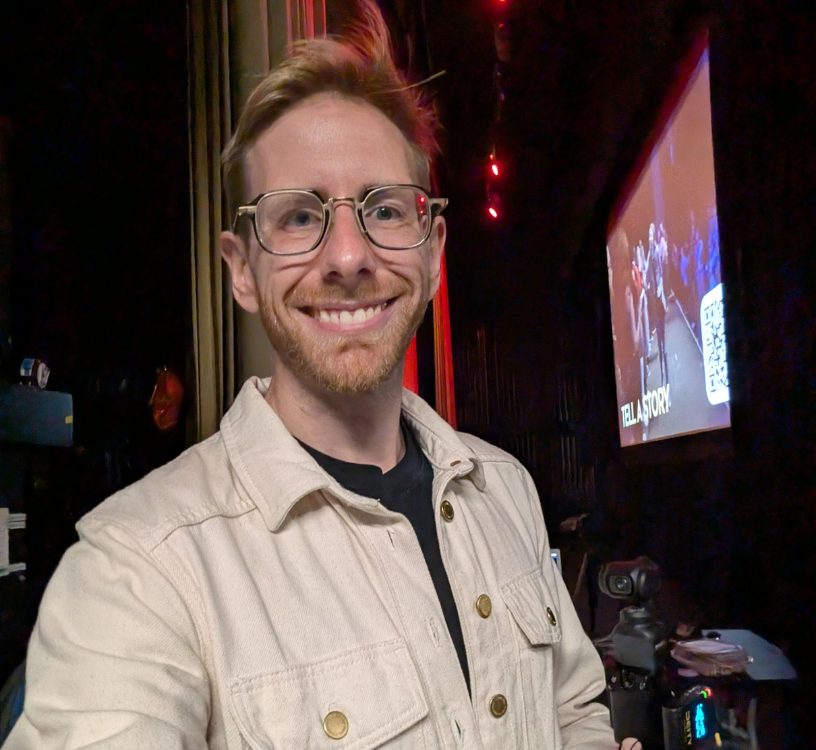
Matt Giombetti is the founder of The Splendid Torch Society. He holds an M.A. in Communication from Johns Hopkins University, where he studied why improv and storytelling are so good at bringing people together. That question has taken him from a practicum with The Moth to volunteering with Story District, and to founding StoryLab, a student storytelling community at Hopkins. Back home in Scranton, he’s putting the research into practice. He takes improv classes at Electric City Improv and is working to bring more storytelling to Northeastern Pennsylvania
